Our community decided in 2008 that the mission of our parish was life-long learning. Everything we do centers around teaching the depth and richness of the Roman Catholic Faith. Our weekly 3-Minute Catechesis is read from the Ambo prior to Mass beginning. A written copy is made available in our weekly bulletin along with additional information for those who want to learn more. Visit us online at www.risensaviorcc.org for more information.

Thursday, September 16, 2010

End of Life - Hospice


With a growing elder population in the United States, there are questions about the Church’s stand on issues like assisted suicide and euthanasia, and programs like hospice. Over the next weeks, we will be addressing end-of-life issues like these, and what the Church teaches.

End-of-life issues have been thrust into the spotlight in recent years by the debate surrounding several states’ attempts to legalize physician-assisted suicide. Supporters of physician-assisted suicide point to the potential physical suffering and loss of independence associated with terminal illnesses. They argue that when faced with the side effects of treatments like chemotherapy and the general loss of dignity, many patients achieve a sense of peace when told of alternatives, like taking an overdose of doctor-prescribed drugs. There are, however, very few doctors who support physician-assisted suicide and would be willing participate in this.
Additionally, providers of hospice care say that services are already available to help people with terminal illnesses live and die in comfort, control, and dignity, without the moral and practical problems raised by physician-assisted suicide.
What is hospice?

Hospice is care for people with a prognosis of less than six months to live. It aims to control the symptoms and pain associated with a patient’s condition rather than trying to cure it. But hospice is about more than just reducing pain: hospice treats the whole person, treating a patient’s body, mind, and spirit, as well as caring for the family of the patient, who is also affected by the terminal illness.

Contrary to the common misconception that “hospice equals death,” the philosophy of hospice is to neither hasten nor postpone death. Hospice is more about quality of life, and having that until the end of life, than it is about dying.

Hospice providers have become so good at alleviating physical suffering that unbearable pain is no longer a valid argument for assisted suicide. Additionally, the natural dying process allows for patients and their families to experience reconciliation, love, forgiveness: all of the stages that people need to go through to be able to die peacefully.

Last December, Pope Benedict paid a visit to Rome Hospice Foundation and praised the health care workers for the service they provided. Whoever has a sense of human dignity knows, the Pope said, that those with incurable illnesses should be respected and sustained while they face the difficulties and the suffering tied to their health conditions.

First and foremost on the mind of the Church is safeguarding life, our God-given gift.

Friday, September 10, 2010

Crosses and Crucifixes

Early in the 4th century, St. Helena, the mother of the Roman Emperor Constantine, went to Jerusalem in search of the holy places of Christ's life. She had the Temple of Aphrodite leveled, which tradition held was built over the Savior's tomb, and on that site, Emperor Constantine built the Basilica of the Holy Sepulcher. During the excavation, workers found three crosses. Legend has it that the one on which Jesus died was identified when its touch healed a dying woman.

The cross immediately became an object of veneration. At a Good Friday celebration in Jerusalem toward the end of the 4th century, according to an eyewitness, the wood was taken out of its silver container, placed on a table, and touched and kissed by people passing by. Since that time, the Catholic Church has celebrated the Exaltation of the Holy Cross on September 14th, the anniversary of the Basilica's dedication.

In the Roman Church, altar crosses and processional crosses began to be crucifixes in the 11th century. What is the difference between a cross and a crucifix? The difference is that a crucifix has a corpus, which is Latin for body.
There are several reasons why the Catholic Church uses the crucifix as a symbol of our faith. One reason is St. Paul's statement in 1st Corinthians that "we proclaim Christ crucified.” Also, the crucifix is a symbol of what is happening in our liturgy: the re-presentation of the Crucifixion in a non-bloody manner on the altar in the form of the Eucharist.

Many Protestant denominations emphasize the Resurrection over the Crucifixion. Neither is complete in-and-of-itself, but each places a different emphasis on a part of the whole act of salvation offered by Christ. Both Catholics and Protestants recognize that the cross is the most familiar symbol of our Christian faith.

For many who have been at Risen Savior for a few years, the crucifix that hangs in our church has even more significant meaning because of where it came from. The cross was specially made by a parishioner for the corpus, which was donated by Father Edward Rivera. Shortly after his ordination in June of 2003, Father Ed was diagnosed with pancreatic cancer, and after serving this parish for just over a year, he entered eternity.

As you consider the crosses you bear in life, especially on the Feast of the Exultation of the Cross, remember that you have blessed company, and your path is marked with the footprints of your Lord.

Friday, September 3, 2010

Clothing the Naked

The first mention of clothes in the Bible is in the first book, Genesis. After Adam and Eve eat of the fruit of the Tree of the Knowledge of Good and Evil, “the eyes of both of them were opened, and they realized that they were naked.” (Genesis 3:7) This led them to sew some figs leaves into loincloths to wear. Since that time, human beings have been covering their bodies with clothing. Modesty is one of the reasons, but there are practical reasons as well: clothes protect us from the elements of snow, rain, and sun, as well as the bites and stings of insects and wild animals.

There are several hundred references to clothing in Scripture. Some passages describe clothing while others dictate how God’s people are expected to dress. Clothing is mentioned figuratively in Scripture as well: in Psalm 104, God is praised as being “… clothed with majesty and glory...”

In the Gospel of Mark, Jesus objected to people who dressed elaborately to seem more religious (Mark 12:38). Teaching in the synagogue, He said, "Beware of the scribes, who like to go around in long robes and accept … seats of honor in synagogues, and places of honor at banquets… They will receive a very severe condemnation."

We may not know what Jesus looked like, but we know what He wore: John says that Jesus' garment was woven in one seamless piece. In Luke, we are told of a suffering woman who was healed when she touched the tassel on Jesus’ cloak. In this instance, we understand Jesus’ cloak to be an extension of His very self.

The letter of James says that “If a brother or sister has nothing to wear and has no food for the day, and one of you says to them, "Go in peace, keep warm, and eat well," but you do not give them the necessities of the body, what good is it?” (James 2:15-16)

Our Love Your Neighbor initiative for September is collecting clothing for the P.T.A. Clothing Bank. You will find specific needs listed in the lobby, the bulletin, and the Ministry Monthly. Since the number of homeless students is growing, the need is great. As you go through your closets at home, keep in mind that the idea is to donate clothes in such condition that we ourselves would be willing to wear them. In Matthew 25, Jesus said, “Whatever you did for one of these least brothers of mine, you did for me.”

Friday, August 27, 2010

The Right Hand

Why do we make the Sign of the Cross using the right hand rather than the left? Is there a Scriptural preference for the right hand? If so, why?

Scripture has several words translated "right" and the use of the term "right hand" can have a variety of meaning: a direction; the opposite of wrong; what is just; or a place of honor or authority. In the case of bestowing a blessing in the Bible, the right hand or right side came first, and was the greater blessing. This is seen in Genesis 48, when Jacob, before he dies, purposely crosses his arms to put his right hand on the head of Joseph’s younger son, standing at his left, to give him a greater blessing than his brother.

The Bible contains over 100 favorable references to the right hand. In Matthew 25, Jesus places the sheep – who are going to heaven – on his right hand, but places the goats – who are not going to heaven – on his left. And we recite in the Nicene Creed that Jesus is "seated at the right hand of the Father.”

Where does this right-handed preference come from? To answer that question, we have to go back in history.

One theory is that in the hunter-gatherer period, women needed to hunt alongside the men and protect their young children. The woman carried the infant on the left side of her body where the heartbeat is stronger, keeping the infant more secure and quiet, leaving the right hand for throwing spears. This may have led to preferential right-handedness.

In Medieval times, an open right hand indicated you were not carrying a weapon. If two men met and displayed empty right hands, they could assume they would not be attacked by the other. This evolved into the handshake.

Scientists estimate anywhere from 70-95% of people are right-handed. Probably because of this, the right hand is traditionally the hand of blessing and greeting in many cultural settings.

By contrast, the left hand has, in many cultures, a different set of traditional associations. For example, in Islam, the left hand is seen as unclean, stemming from a Middle Eastern custom of using the left hand for hygienic purposes.

In Latin, the word for “right” is dexter while the word for “left” is sinister. Many people, even today, associate left-handedness with evil, but in most educated populations, this is considered superstition. Nevertheless, for many of the reasons listed above, the sign of the cross has traditionally been made with the right hand.

Thursday, August 19, 2010

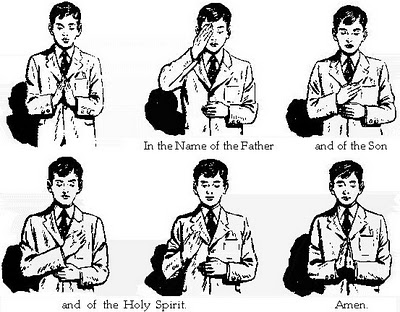
The Sign of the Cross


Watching the recent World Cup soccer games or other athletic events, you may notice how many players bless themselves with the Sign of the Cross during a game. Some athletes may be putting themselves in God’s presence, while others are thinking that there is magic in this gesture of faith. Even in formal prayer, the Sign of the Cross can be routine, just the traditional way of starting and ending prayer. But this gesture is so much more.

The Sign of the Cross is the most often used prayer of Christians and probably the first prayer we learned as children. As simple as it seems to us, the Sign of the Cross is more than just a gesture – it is an ancient prayer. References to it appear in writings dating back to 240 A.D.

Initially, the Sign of the Cross was made with the thumb, usually on the forehead, but sometimes on the lips and chest. This small Sign of the Cross was in common use by the end of the 4th century and is still used today at every Mass, with the sacraments of Baptism, Confirmation, and the Anointing of the Sick. It is also used for the R.C.I.A. Rite of Signing and marking the forehead with ashes on Ash Wednesday.

By the 6th century, people were using the first two fingers, held together to make a wider Sign of the Cross, touching the forehead, chest, and shoulders. The two fingers symbolized the divine and human natures of Christ.

The use of three fingers became popular in the 9th century. The thumb and first two fingers were held outstretched together to symbolize the Trinity, while the remaining two fingers were bent to signify Christ's two natures. This form is still used in Eastern Christian churches, where the right shoulder is touched before the left.

By the end of the Middle Ages, the Western Church had adopted the practice of making the large Sign of the Cross with an open hand and touching the left shoulder before the right. This is the form we Roman Catholics continue to use today.

When we make the Sign of the Cross on ourselves, we aren’t doing anything “magical.” Rather, we are expressing our belief in God and the Trinity and reminding ourselves of God's love for us, of the sacrifice Jesus made to give us eternal life, and of the presence of the Holy Spirit within us.

Thursday, August 12, 2010

Feast of the Assumption of Mary


On November 1, 1950, Pope Pius XII solemnly declared: “By the authority of our Lord Jesus Christ, of the Blessed Apostles Peter and Paul, and by our own authority, we pronounce, declare, and define it to be a divinely revealed dogma: that the Immaculate Mother of God, the ever Virgin Mary, having completed the course of her earthly life, was assumed body and soul into heavenly glory.”

In spite of the 1950 pronouncement, the Feast of the Assumption goes back to apostolic times. It was originally celebrated in the East, in the areas around Turkey and Greece, where it is known as the Feast of the Dormition, a word which means "the falling asleep."

Like the doctrine of the Trinity, the Assumption is not explicitly mentioned in Scripture. The Roman Catholic Church declared this dogma based on three things: the historic teaching of the Church down the centuries, the scholastic arguments in favor of it, and its interpretations of biblical sources.

One of those biblical sources is the book of Revelation, where the author John writes about his heavenly vision: "Then God’s temple in heaven was opened, and the ark of his covenant was seen within his temple." (Rev. 11:19) Immediately after seeing the Ark of the Covenant in heaven, John continues: "And a great portent appeared in heaven, a woman clothed with the sun, with the moon under her feet, and on her head a crown of twelve stars; she was with child." (Rev. 12:1–2) The woman is Mary, the Ark of the Covenant, revealed by God to John.

The Ark of the Covenant was the chest that held the two stone tablets of law which Moses brought down from Mount Sinai and was also “a sanctuary” for God, that he “may dwell in their midst.” (Ex. 25:8). Mary is the Ark of the New Covenant: as the mother of Jesus, she provided a place for God to dwell – in her womb. God honored Mary by taking her, body and soul, into Heaven.

In the U.S., there are many cities that have Assumption Day parties with music, dancing, parades and fireworks, with one of the largest festivals taking place in Cleveland, Ohio. This, however, pales in comparison to the extravagant celebrations in more than 50 countries around the world, where the Assumption is celebrated on August 15th as a public holiday. How wonderful that our Blessed Mother is remembered on her heavenly birthday!

Friday, August 6, 2010

The Transfiguration

On Friday, August 6th, the Church celebrated the feast of the Transfiguration of the Lord. The word “transfiguration” comes from the Latin trans, which mean across, and figurare, which means form or shape. The Transfiguration was the change in appearance of Christ before his disciples.

All three Synoptic Gospels – Matthew, Mark, and Luke – tell the story of the Transfiguration. Jesus led his select disciples, Peter, James and John, up on a high mountain. In the Old Testament, mountains are sacred places where people encounter God. The same is true here. What started as a mountain retreat quickly changed as Jesus was transformed right before the eyes of the disciples. Matthew says that Jesus’ face shone like the sun, and both Matthew and Mark use the word transfigured to describe what happened to Jesus. For this brief time, Jesus took on an appearance more appropriate for the King of Glory than for a humble man.

God’s voice comes from a cloud overshadowing the mountain and He reveals to the disciples that Jesus is His beloved Son. Moses, representing the law, and Elijah, representing the prophets, also appear with Jesus. The appearance of these two Old Testament heroes confirms that Jesus is the fulfillment of both the Law and the prophets.

Inquiring minds want to know: since there weren’t photographs of Old Testament people and not even good written descriptions, how did the disciples know that the men who appeared with Jesus were Elijah and Moses? Scripture doesn’t say. It seems that the disciples just knew. This perhaps illustrates that we will instinctively know each other when we get to heaven.

With remarkable agreement, the three evangelists Matthew, Mark, and Luke place the event shortly after Peter’s confession of faith that Jesus is the Messiah and Jesus’ first prediction of his passion and death. One of the Transfiguration accounts is read on the second Sunday of Lent each year, proclaiming Christ’s divinity to catechumens and baptized alike. The Gospel for the first Sunday of Lent, by contrast, is the story of the temptation in the desert – affirmation of Jesus’ humanity. The two distinct but inseparable natures of the Lord – his humanity and divinity – are revealed.

The witnessing of the Transfiguration by Peter, James, and John didn’t just involve the changed appearance of Jesus – it changed how they looked at him. Even if they failed to fully understand what we understand today – that Jesus was God become man – they knew that he shared a special connection with God and with the revered Old Testament prophets.